The MBA Price-Increase Flash Sale, Cracked Open
$1k/Day Experiment · Behind the Build
The MBA Price-Increase
Flash Sale, Cracked Open
Six days, 35 enrollments, $41,104 banked and $65,340 under contract on $523 of ads. Three sales pages with three wildly different conversion rates. Here's every stage, every leak, and the arithmetic on both.
MEMBERS-ONLY TEARDOWN · JULY 30 – AUGUST 4, 2026
START HERE
Why this one's worth studying
This was a flash sale with no webinar, no live event, no launch runway. Seventeen emails, one partner, one small retargeting campaign, and a deadline. That's it. Which makes it unusually clean to study: there are only four levers in this machine, so when something works or leaks you can actually see which lever did it.
It's also the launch type most of you can run this month without building anything new. So I'm showing you the whole thing, including the parts where I gave away margin I didn't have to and the parts where I still can't fully explain the number.
| THE HONEST HEADLINE35 people enrolled and I cleared my Good goal by 40%. I also missed Better by 15 sales, discounted 25 of the 35 sales on a launch whose entire premise was that the price was going UP, and ran a brand-new sales page that converted 2.7× better than the old one — a fact I only found out afterward, by looking. |
|---|
The setup
- The event: a six-day MBA flash sale, July 30 – August 4, closing at midnight ET. The hook: the price goes up after this.
- The offer: MBA at $1,997 pay-in-full or $217/mo × 12. At checkout, a $97 Sponsor Spotlight order bump, plus a choice of sponsor solo email upsell — one for $375 or a bundle of three for $900, both 25% off.
- The bonuses: full-price buyers got lifetime access to the $1k/Day Experiment ($397 value). Jenna's buyers got her Pinterest course instead, at the same dollar value, as part of her partner deal.
- The channels: 17 emails to ~10,000 subscribers, a $523 Meta retargeting campaign, a Voxer pop-up group, and Jenna Kutcher promoting to her list with a $500-off code at 50% commission.
- The targets: Good 25 sales, Better 50, Best 100.
AGAINST THE TARGETS
Goals: good, better, best
I set the targets in units rather than dollars, because unit count is the thing traffic actually moves. Here's where they landed.
| TIER | TARGET | RESULT |
|---|---|---|
| Good | 25 sales | cleared — 35 |
| Better | 50 sales | missed — 70% there |
| Best | 100 sales | missed — 35% there |
| THE REAL QUESTIONClearing Good is fine. The interesting question is what 15 more sales would have required, and the answer isn't better copy. At my 8.95% checkout conversion, 15 more sales needs ~170 more people at checkout. I had 380. The constraint was how many humans I put into the top of the funnel. |
|---|
Banked vs. booked
These are two different numbers and mixing them up is how people either panic or celebrate for no reason. Banked is cash that hit my account during the sale. Booked is cash these same 35 people are contractually committed to over the next twelve months on their payment plans. Neither one is wrong; they answer different questions.
| BANKED — CASH IN THIS WEEK | AMOUNT |
|---|---|
| MBA core revenue (34 Kartra sales) | $37,137 |
| $97 Sponsor Spotlight bump (11 taken) | $1,067 |
| $900 sponsor solo bundle (1 taken) | $900 |
| 1 sale via Elective (outside Kartra) | $2,000 |
| Total banked — 35 sales | $41,104 |
| BOOKED — OWED TO ME OVER 12 MONTHS | AMOUNT |
|---|---|
| 12 payment plans × 11 remaining payments | $24,236 |
| Banked this week | $41,104 |
| Total contract value of this sale | $65,340 |
| WHICH NUMBER TO USE WHEN****Use banked to answer "can I pay for this launch?" Use booked to answer "what is a customer worth, and what can I afford to pay to get one?"My cash AOV is $1,174. My contract AOV is $1,867. If I judge my ad spend on the cash number I will undervalue every customer by 59% and kill campaigns that are actually paying for themselves. The catch: booked is a promise, not money. Plans fail. Judge ads on contract value, but pay bills out of banked. |
|---|
Who actually bought
35 buyers. 26 in the US, 4 Canada, 2 Australia, 1 UK, 1 Finland. The splits that matter are how they paid and what they paid.
| BUYER PROFILE | COUNT | REVENUE |
|---|---|---|
| Paid in full | 22 (63%) | $34,934 |
| Payment plan (12 months) | 12 (34%) | $2,203 first payments |
| Used a discount code | 25 (71%) | $9,401 given away |
| Paid full price, no code, no affiliate | 6 (17%) | $6,642 |
| Took the $97 bump | 11 (31%) | $1,067 |
| Took a sponsor solo upsell | 1 (3%) | $900 (the bundle) |
| THE BONUS SPLITFull-price buyers got lifetime $1k/Day access ($397). Jenna's buyers got her Pinterest course at the same value. Same perceived generosity, two different fulfillment costs — and the Jenna version costs me nothing at all, which is worth remembering when you structure a partner deal. |
|---|
THE ARCHITECTURE
The whole machine
A flash sale is a much simpler machine than a webinar launch. Four moving parts, traffic flowing one direction. Here's how it actually ran.
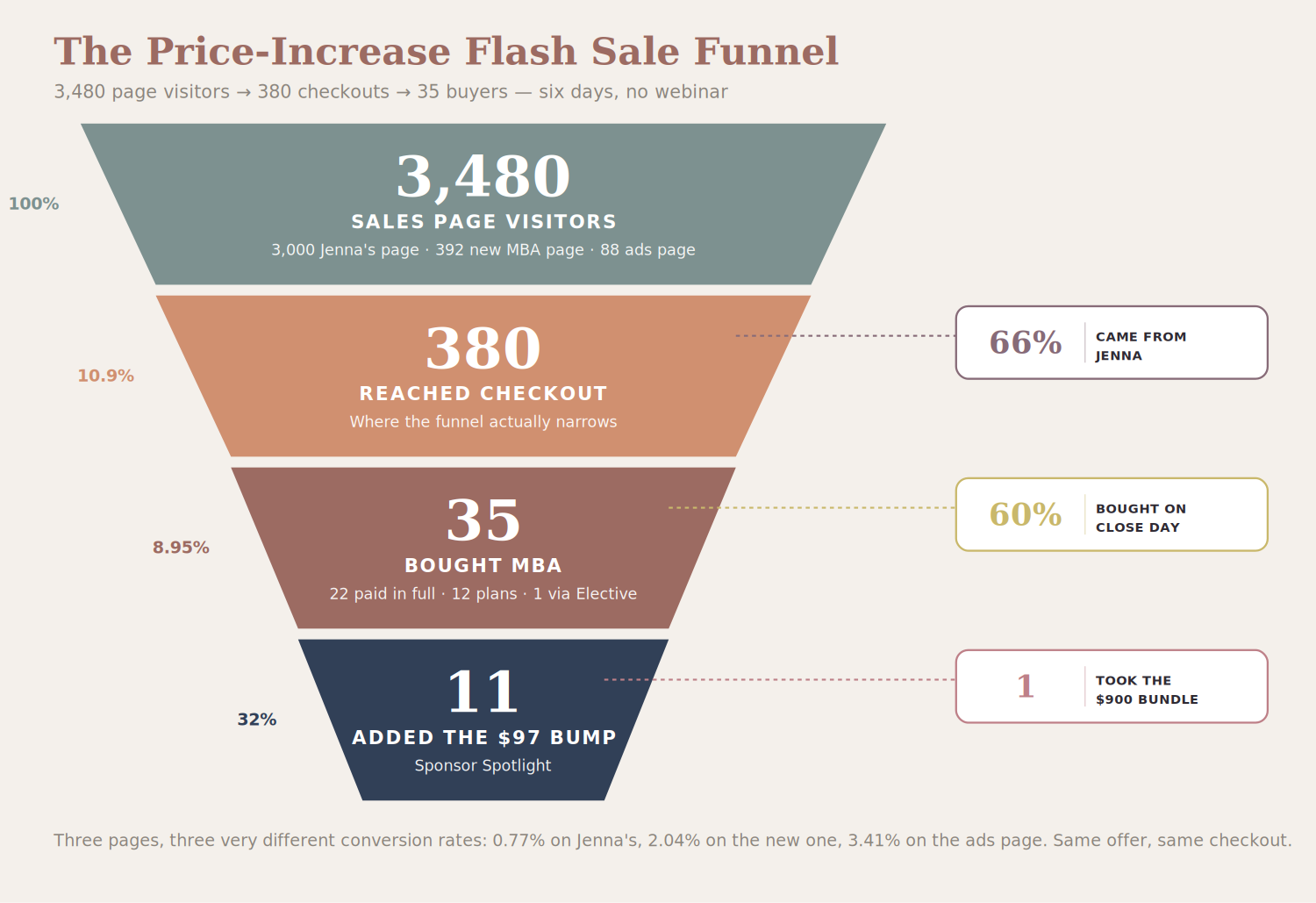
Attribution note: 23 sales carry Jenna's affiliate tag, 3 are credited to the ads campaign by Meta's own click path, and I've assigned the remaining 8 Kartra sales to the new MBA page. Lorrie's $2,000 came through Elective and touched none of these pages.
The stages, walked
Stage 1 · Three sales pages
3,000 visitors on Jenna's dedicated page (the old one), 392 on my brand-new MBA page, 88 on the ads-specific page. Three very different conversion rates, broken out in the next section.
Stage 2 · 17 emails over 6 days
45.3% average open rate, which is excellent. 0.43% average click rate, which is not. 44 unique clicks per send on a 10,000-person list. 372 unsubscribes across the sequence.
Stage 3 · Checkout
380 people reached the MBA checkout page. 34 bought there. 8.95% conversion, which for a $1,997 offer is a healthy number — the checkout is not the problem.
Stage 4 · Bump + upsell
11 of 35 added the $97 Sponsor Spotlight (31% attach). One person took a sponsor solo, and chose the $900 bundle over the $375 single. Zero people took the $375. Both bump and upsell carry no affiliate commission.
THE SHAPE OF THE LAUNCH
Sales by day
The shape of a deadline-driven sale with no live event in the middle: five quiet days and one enormous one.
| DAY | SALES | REVENUE | % OF SALE |
|---|---|---|---|
| Thu Jul 30 | 2 | $1,714 | 4.2% |
| Fri Jul 31 | 1 | $260 | 0.6% |
| Sat Aug 1 | 1 | $314 | 0.8% |
| Sun Aug 2 | 2 | $2,994 | 7.3% |
| Mon Aug 3 | 7 | $9,745 | 23.7% |
| Tue Aug 4 (close) | 21 | $24,581 | 59.8% |
| Wed Aug 5 (after close) | 1 | $1,497 | 3.6% |
| THE LAST HOUR****Six sales landed between 11pm and midnight on the final day: $9,742. That's 24% of the entire launch in sixty minutes. The final six hours did $15,686 — 38% of the sale.Then one more Jenna sale came through at 9:22am on August 5, nine and a half hours after the cart was supposed to be shut. I don't know how that happened — a checkout page that didn't expire, most likely. I'll take the $1,497, but it needs finding before the next launch, because a deadline you don't enforce is a deadline your list stops believing. |
|---|
THE PAID ENGINE
Paid ads: the $523 experiment
My plan for ads on this launch was deliberately simple: budget roughly the cost of one sale, run retargeting to my warm audience for the six days the cart was open, and see what happened. No scaling mid-flight, no daily fiddling. Gather data, adjust next time. Here's what the data actually says — and where I'm honestly still guessing.
| AD METRIC | NUMBER |
|---|---|
| Spend (6 days, ~$87/day) | $523.15 |
| Audience targeted (all warm leads, excl. MBA buyers) | 34,400–40,500 |
| People actually reached | 2,254 (~6%) |
| Frequency over the flight | 3.6 |
| Link CTR / CPC | 1.24% / $5.18 |
| CPM | $64.25 |
| Landed on the sales page → started checkout | 88 → 24 |
| Purchases | 3 |
| Cost per purchase | $174.38 |
| Estimated ROAS (see note below) | ~6.8x cash · ~11.7x contract |
| HOW I ESTIMATED THE ROAS — AND WHY IT'S AN ESTIMATEI can't see exactly which three buyers came from the ads, so I valued them at my average non-partner sale: about $1,192 in cash and $2,039 in contract value each. On that math, $523 returned roughly $3,600 cash and $6,100 in contract value. Even if you cut those numbers in half to be safe, the experiment paid for itself. Three purchases is a small sample, though — I'd want a second flight before I trusted these ratios as anything more than an encouraging first read. |
|---|
What I think happened under the hood
A few things in the account data surprised me, and I want to share my working hypotheses — with the caveat that some of this is educated guessing, because Meta doesn't hand you clean answers.
- The campaign probably never exited the learning phase. A purchase-optimized campaign wants something like 50 conversions a week to stabilize; mine got 3 in six days. My best guess is that's why my CPM ran $64 against my usual $21–28 — I was paying a premium for impressions while Meta guessed at who to show them to. A six-day flight on a $1,997 product may simply be too short a runway for purchase optimization to find its footing.
- Meta reached beyond my warm audience, even though I'd turned Advantage+ audience off. About 40% of the spend went to people Meta classifies as a new audience — people not on my list at all. My working theory is the separate 'Advantage custom audience' expansion setting (it's a different toggle than Advantage+, and it's on by default when you attach a custom audience), but I haven't confirmed that yet. Interesting wrinkle: that new-audience spend still produced one of the three sales, so the expansion wasn't wasted money — it just wasn't the campaign I thought I was running.
- $64 went to existing customers of my other products at a frequency of 6.6, with zero sales. Small dollars, but seven impressions each for people who already buy from me elsewhere feels like an audience I might want to target even more in the future (even though this time it got 0 sales).
- I only touched ~6% of my warm audience. Roughly 32,000+ warm leads from my retargeting pool never saw the ad once. Daily reach was still climbing and daily frequency never passed 2.4 when the sale ended, and my cost per purchase came down over the last two days of the flight ($78 → $57). Two days of purchase data is far too thin to declare a trend, but it reads like the campaign was still finding new people when the deadline shut it down — not like it had run out of audience.
| WHAT I'LL TEST NEXT TIMEThese are hypotheses to test, not conclusions: Start earlier. The sale window is fixed, so the fix for a too-short flight isn't running past the deadline — it's warming up the campaign before cart open so the learning happens on my schedule, not during my selling window. Optimize for a mid-funnel event. Landing page views ran at a volume Meta can actually learn from (~100/week); purchases never will at this price point. Lock the targeting down. Untick the Advantage custom audience expansion, add hard exclusions (those are the one thing Meta always honors), and re-check the audience segment breakdown mid-flight instead of after. Step the budget gently during the window and watch cost per purchase — if it holds anywhere near this flight's numbers, the next experiment earns a bigger budget. If it doesn't, I'll have learned that for the price of a few sales, which is exactly what a test is for. |
|---|
THE PARTNER ECONOMICS
What Jenna cost, said plainly
I don't pay a commission on every sale. I pay 50% on the sales Jenna brings, and nothing on the sales I bring. So the useful comparison isn't a percentage of total revenue — it's what I keep per sale, from each source.
| JENNA'S SALES | MY DIRECT SALES | |
|---|---|---|
| Number of sales | 23 | 12 |
| Banked | $25,987 | $15,117 |
| Commission out | –$12,156 (50%) | $0 |
| Kept | $13,832 | $15,117 |
| Kept per sale | $601 | $1,260 |
| THE NUMBER THAT MATTERS****A sale I generate myself is worth 2.1× a sale Jenna generates, in cash to me. That is not an argument against the partnership — she brought 23 buyers I had no other way to reach, and 23 × $601 is still $13,832 I wouldn't otherwise have.It IS an argument for spending real money on my own traffic. Every direct sale I can manufacture is worth more than double a partner sale, and I have far more control over the volume.Across the full contract, including commission on future plan payments, Jenna's total take is $19,615 on $65,340 of contract value. |
|---|
WHERE THE TRAFFIC WENT
Three sales pages, three conversion rates
This is the section I'd study hardest if I were you, and it's the one I most wish I'd looked at during the sale instead of after it.
| PAGE | VISITORS | SALES | CONVERSION |
|---|---|---|---|
| Jenna's page (old design) | 3,000 | 23 | 0.77% |
| New MBA sales page | 392 | 8 | 2.04% |
| Ads landing page | 88 | 3 | 3.41% |
| 'Is MBA Right For You' quiz | 69 | — | 2:44 avg time |
| All pages → checkout | 3,480 | 380 | 10.9% |
| Checkout page → buyer | 380 | 34 | 8.95% |
| READ THE COMPARISON CAREFULLY****The new page converts 2.7× better than the old one. The ads page converts 4.4× better. Same offer, same price, same checkout behind all three.But this is not a clean A/B test and I won't pretend it is. Jenna's 3,000 visitors are a semi-cold borrowed audience who'd never heard of me before that week. My 392 and the ads page's 88 are people already on my list or already retargeted. Warm traffic converts better than cold traffic; that alone could explain the whole gap.What the comparison honestly says: Jenna's page is doing hard qualifying work on cold traffic and its 80.8% bounce rate is the tell. Before the next JV I want to rebuild that page in the new design and run the actual test, because if even a third of that 2.7× is design rather than temperature, that's 15 more sales from the same 3,000 visitors. |
|---|
THE ENGINE THAT CARRIED IT
The email engine
Seventeen emails in six days to roughly 10,000 people. The open rates are the best in my business. The click rates are the worst number in this entire debrief.
| EMAIL METRIC | NUMBER |
|---|---|
| Emails sent in the sequence | 17 |
| Average open rate | 45.3% |
| Average unique clicks per email | 44 |
| Average click rate | 0.43% |
| Click-to-open rate | 0.94% |
| Best performer | #2 Voxer Invite — 68 clicks |
| Worst performer | #12 Closes Tonight — 28 clicks |
| Existing MBA buyers suppressed | 554 |
| READ THIS ONE TWICE****About 4,800 people opened each of these emails. About 44 clicked. Ninety-nine out of every hundred people who opened my sales email during my own price-increase deadline did not click anything.Notice which email won: the Voxer pop-up invite, not any of the pitch emails. My list will click an invitation to talk to me. The 'Closes Tonight' email — arguably the most urgent send of the sequence — was the single worst clicker of all 17.The open rate says my subject lines and sender reputation are excellent. The click rate says the inside of the emails isn't giving people enough of a reason to move. |
|---|
Unsubscribes and opt-outs: the ledger
Every launch sequence has a cost side, and I want to look at mine without flinching in either direction — not spinning it as 'bless and release,' not catastrophizing it either. Here's what actually happened to the list across seventeen emails in six days.
| LIST METRIC | NUMBER |
|---|---|
| Emails in the sequence | 17 |
| Average open rate (first send → last send) | 45.3% (46.9% → 41.9%) |
| Unsubscribes across the sequence | 372 (~3.7% of the send audience) |
| Average unsubscribe rate per send | 0.22% |
| MBA promo opt-outs, before → after | 41 → 111 (+70) |
| Sales from my own list (non-partner) | 12 |
| Highest-unsubscribe send | #9 Money Math — 42 (0.40%) |
| WHAT THE NUMBERS SAY, AND DON'T****The engagement signal is reassuring. Open rates held in the mid-40s through all seventeen sends, easing only about five points from first email to last. A list that felt abused would show it in the opens first — mine kept opening.The attrition is real but hard to grade without history. 442 people either unsubscribed or permanently opted out of MBA promotions, against 12 sales the sequence produced from my own list. You can frame that harshly (37 departures per direct sale) or gently (96% of recipients stayed, and many of the leavers were never going to buy a $1,997 program). Both framings are true, which is exactly why I now have a baseline — next launch I'll know whether 4.4% attrition is my normal or my ceiling.Some of this probably wasn't this sequence's fault. My Gemma JV promotion ended July 28 and this sale teased July 29 — back-to-back campaigns with one day of daylight. I included Gemma's audience in only 3 of the 17 sends, and those 3 averaged a slightly higher unsubscribe rate (0.27% vs. 0.20%) — including the single worst send of the whole sequence, which went out days after her audience finished a twenty-email campaign of her own. I can't cleanly separate campaign fatigue from sequence length from audience mismatch. My honest guess is all three contributed, and the spacing is the one I most control. |
|---|
| WHAT I'M TRACKING FROM NOW ONOpt-outs per launch, not just all-time (41 → 111 only means something if I measure it every time). Unsubscribe rate against this sequence as the benchmark. And at least a week of breathing room between campaigns — the calendar did my list no favors this time, and that one was a choice. |
|---|
THE ASSET THAT TRAVELED
The replay, which almost nobody finished
Jenna's webinar replay lived on her sales page for the whole sale. Here's what 3,000 people on her sales page actually did with it.
| REPLAY METRIC | NUMBER |
|---|---|
| Views, Jul 30 – Aug 4 | 304 |
| Views as a share of Jenna's page traffic | 10.1% |
| Total watch time | 85.0 hours |
| Webinar length | 2:10:09 |
| Average watch time | 16.8 min — 12.9% of it |
| New viewers | 98.2% |
| Watch time from non-subscribers | 99.9% |
| Watched on mobile | 57.1% |
| THE REPLAY DID NOT SELL THIS LAUNCH****The average person watched 16.8 minutes of a 130-minute webinar. On a webinar that long, the pitch lands somewhere past the ninety-minute mark. Almost nobody who watched the replay ever reached it.And yet 23 people bought from Jenna's page. **So the sales page and her emails did the selling, and the replay functioned as a credibility object — something people clicked, sampled for a quarter of an hour, and left.**The view shape says the same thing: a spike on day one, near silence through the middle, and only a modest bump on the close days. Nobody came back to the replay to decide. |
|---|
| THE LEAK NOBODY MENTIONS****304 people watched 85 hours of our webinar. 98.2% were brand-new viewers and 99.9% of the watch time came from non-subscribers.That is a completely borrowed audience passing through my house and leaving no forwarding address. Jenna sent them, they sampled me, and I captured almost none of them anywhere I control. Every JV replay should have a subscribe ask, an end screen, and a link out to my own list — this one had none of that working. |
|---|
STEAL THIS ONE
The Voxer pop-up — a volume and engagement failure
I opened a Voxer group for the sale. I've run this play before and it has been one of my highest-converting mechanisms. This time it barely functioned, and the reason is not the mechanism.
- 145 people in the group — but most were carryover from previous launches, not new.
- Only 11 joined during this launch. That's the first failure, and it's a volume failure.
- Only 2 people asked a question. That's the second failure, and it's an engagement failure.
- Both people who asked a question bought. 100%, on a sample of two.
- 3 of the 145 total members bought — 2.1% — worth $3,157, about 8% of launch revenue.
- For comparison: past pop-ups have converted question-askers at 60% and 35%.
| WHAT ACTUALLY BROKEThe 2-for-2 conversion is a sample too small to celebrate, but it's consistent with a pattern I already have evidence for: **people who speak in the room buy at somewhere between 35% and 100%. People who merely sit in it buy at 2%.**So the mechanism works. What failed was getting people into the room and getting them to open their mouths once they were there. 11 joins and 2 questions across a six-day sale is not a conversion problem, it's an activity problem — and it's mine, because I didn't post enough to give anyone a reason to respond.The irony: the Voxer invite email was the highest-clicking email of the entire sequence. My list wanted in. I opened the door and then didn't stand in it. |
|---|
THE HONEST MATH
Money left on the table
The honest part. Ranked by size, which makes this my to-do list rather than my confession.
1. The warm audience I barely reached — the biggest one, unsized
Getting to 50 sales needed ~170 more people at checkout. My ads reached about 6% of a 34,000+ warm audience on a deliberately small $523 test — which means the most obvious untested lever is simply running that experiment bigger and earlier. I won't put a fake number on it, because a test at ten times the budget may not perform ten times as well. The point is I don't know yet, and finding out is one of the most valuable things I can do before the next launch.
2. Email click rate — ~$19,000
0.43% average click rate against a 45.3% open rate. If the sequence had converted opens to clicks at a still-modest 2% CTO instead of 0.94%, that's roughly double the traffic into checkout — about 190 more people at 8.95% conversion and $1,174 cash AOV. The audience is already opening. The emails aren't earning the click.
3. 304 replay viewers I never captured — unsized, but strategic
98.2% new viewers, 99.9% of watch time from non-subscribers, and 2 subscribers gained. Jenna handed me 304 people who watched 85 hours of my content and I have no way to follow up with any of them. A subscribe ask, a working end screen, and a link to my own opt-in on that replay costs nothing and compounds across every future JV.
4. The old Jenna sales page — potentially ~15 sales
0.77% conversion on 3,000 visitors versus 2.04% on the new page. Cold traffic explains part of that gap and I won't claim it explains none of it. But if even a third of the difference is design, rebuilding that page is worth roughly 15 sales on the same borrowed audience — more than the entire gap to my Better goal.
5. Discount leakage — ~$2,000
DAILYSALES500 and STRATEGY each gave $500 off to buyers outside the partner deal. These come from other funnels, so that’s cool to see them converting during this week too (I’m just not sure how much the flash sale impacted these sales).
6. The sponsor solo upsell — ~$2,200
One person in 35 took it, and took the $900 bundle. Nobody took the $375 single. The $97 bump hit 31%, so the checkout page can sell — it's the solo offer that isn't landing. A three-figure ask right after a $1,997 charge may simply be the wrong moment.. And maybe the $375 isn’t right either. Or just too many options? We usually upsell to $1k/Day here but because of the bonus we swapped it out.
7. The Voxer room — unsized but real
11 joins and 2 questions on a mechanism that has historically converted question-askers at 35–60%. No dollar figure I'd defend, but the gap between 2 conversations and what this play has produced before is not small.
8. 70 MBA opt-outs — a cost, not a leak
70 people permanently opted out of MBA promotions during the six days, on top of 372 unsubscribes. That's 442 people gone against 12 direct sales. It isn't money left on the table exactly — it's the price I paid for this sequence, and I want it on the ledger so I can tell next time whether it went up or down.
| WHY THE CLICK RATE IS THE ONE THAT SCARES METhe ad question is the biggest and it's an experiment I can simply run. The click rate is the one that says something structural. Ninety-nine percent of the people who opened my highest-stakes email of the quarter chose not to click. That's not a problem I can buy my way out of. That's my list telling me something about what my sales emails are asking them to do — and the fact that the invite-to-talk email out-clicked every pitch email is the clue. |
|---|
Notes for next time
What I said I'd fix last time
- Run retargeting during the sale — done, and even as a deliberately small test it returned roughly 6.8× on cash.
- Use a hard deadline with a real close — mostly done, but I think a tech glitch did allow one sale almost 10 hours later, which I still don’t understand how.
- Add an order bump at checkout — done, and it worked: 31% attach, zero commission owed on it.
What I'm changing next time
1. Give the ad campaign a longer runway: start it before cart open and optimize for a mid-funnel event (landing page views, not purchases), so the learning phase happens before my selling window instead of during it.
2. Lock the ad targeting down — untick the Advantage custom audience expansion, set hard exclusions, and check the audience-segment breakdown mid-flight instead of after.
3. Rebuild Jenna's sales page in the new design and actually measure it. A 2.7× conversion gap on 3,000 visitors is the largest single lever in this launch.
4. Rewrite the middle of the sales emails, not the subject lines. 45% open, 0.43% click — the problem is entirely below the fold.
5. Put a subscribe ask and an end screen on every JV replay. 304 viewers, 2 subscribers, is a rounding error where an audience should be.
6. Track MBA opt-outs before and after every launch. 41 → 111 is the kind of number that only means something if you measure it twice.
7**.** Find the checkout that stayed live past midnight and automate the shutoff.
8**.** Post daily in the Voxer group with a specific question. The invite email out-clicked everything — the demand was there… although only 11 people joined, so maybe not? Is there friction there?
9**.** Reposition the sponsor solo upsell, or move it out of the immediate post-purchase moment.
THE WHOLE POINT
What you can steal
1. Separate banked from booked, and use each for its own job.
Banked pays your bills. Booked tells you what a customer is worth. My cash AOV was $1,174 and my contract AOV was $1,867 — judging ads on the first number undervalues every customer by 59%.
2. Measure a partner by kept-per-sale, not by commission percentage.
'31% of revenue went to affiliates' is a confusing number when you only pay on some sales. '$601 kept per partner sale vs $1,260 per direct sale' tells you exactly what to do next.
3. Know what your ad metrics are actually counting.
I nearly drew the wrong conclusion from 'reach: 2,254' — that's how many people Meta served the ad to, not how big my audience was (34,000+). The same number can argue for opposite moves depending on what it actually measures. Check before you decide.
4. Size an ad test to the cost of one sale, then actually read it.
I budgeted roughly one sale's worth of spend, let it run the full window untouched, and came out with a ~6.8× cash return and a specific list of things to change. A small test you read carefully beats a big budget you guess with.
5. A replay nobody finishes is a credibility object, not a sales tool.
Average watch was 16.8 minutes of a 130-minute webinar — almost nobody reached the pitch. The sales page and the emails did the selling. Know which asset is actually closing before you spend another month producing the wrong one.
6. A great open rate can hide a dead sequence.
45% open looks like a healthy list. 0.43% click says the emails aren't doing the job. Track click-to-open during a launch, not open rate.
7. Your close day is 60% of your launch. Staff it.
21 of 35 sales landed on the final day; six of them in the last hour. Everything before that is setup for one six-hour window.
8. Presence in a community is worth nothing. Participation is worth everything.
2.1% of my Voxer group bought. Of the people who asked a question, historically 35–60% buy. This time 100% of people who asked bought, but only 2 people asked anything. Getting people to speak is the whole game — and that requires you to speak first, daily.
9. A price-increase launch with a $500 coupon in 71% of hands isn't a price-increase launch.
If the premise is that the price goes up, discounting most of your buyers teaches your list that the premise is decorative. NOTE: This is from Claude***…not sure I agree.***
10. Count the opt-outs, not just the sales.
442 people asked me to stop during a sale that produced 12 direct sales. That ratio is either fine or alarming depending on what it was last launch — which is exactly why you measure it every time. I lean towards, “buy or unsubscribe” and the whole you’re not my people, that’s okay, bless and release thing.
That's the whole sale.
Forty-one grand banked, sixty-five under contract, and a $523 experiment that just earned itself a bigger budget. That's what a debrief is for.