This Is How We Claude, Cracked Open
$1k/Day Experiment · Behind the Build
This Is How We Claude,
Cracked Open
A free 100-page guide, 31 days, 6,075 opt-ins, 599 VIP Pass buyers, and $49,099 banked — $1,584 a day for the whole month, mostly while I was doing school pickups. Also: the backend offer that sold exactly zero, and the four other places I left real money on the table. Here's the whole machine, wires exposed.
MEMBERS-ONLY TEARDOWN · AUGUST 2026
START HERE
Why this teardown is different
This wasn't a webinar launch or a deal week. It was my first hosted collab event: 17 entrepreneurs (me included) each answered one nosy question — how are you ACTUALLY using Claude? — and donated a free gift. The guide was free all month. The money came from the ladder underneath it: a $47 tripwire right after opt-in, a $67 public price, a $27 bump, a $297 one-click upsell, and four sponsors who paid $1,000 each for placements.
One more thing that makes this one unusual: Claude built most of it. The pages, the 100-page PDF, the 16-email sequence, the automations, this teardown. I architected and approved; the production cost was close to zero. That changes the margin math on everything below.
| THE PRODUCTION LINE ITEMA launch like this normally carries thousands in design, copywriting, and VA hours. This one's production line item was my Claude subscription. Remember that when you read the margin. |
|---|
The setup
- The free thing: a 100-page PDF guide — 17 real Claude workflows, one free gift per contributor. Free Aug 1–31, then genuinely gone.
- The paid thing: the VIP All Access Pass — all 17 pre-built skills ($1,500+ a la carte), the live roundtable + replay, and a private podcast version. $47 as a post-opt-in tripwire with an honest 30-minute countdown, $67 on the public page.
- The stack: Brand iOS at $27 as the checkout bump, Scale Smart at $297 as the one-click upsell, and Scale with AI at $100 off ($497) as the post-roundtable backend.
- The engine: Meta ads + 6 guide promo emails + 7 VIP emails + 2 buyer emails + 16 contributor-affiliates at 50% commission + 4 paid sponsors.
- The dates: live Aug 1–31, roundtable Aug 25, gifts and skills claimable through Sept 30.
The money
Everything below is banked cash from the August Kartra export. There are no payment plans on any of these products, so banked and booked are the same number for once.
The launch's own stack did $49,099 gross ($49,052 after two tiny refunds). On top of that, TIHWC buyers spent another $14,836 on my other offers during August — $5,752 of it after the pass purchase, including three MBA joins — which is the ecosystem doing what it's wired to do.
| LINE | AMOUNT |
|---|---|
| VIP All Access Pass — 599 paid sales | $30,118 |
| Brand iOS bump — 252 taken (42.1%) | $6,804 |
| Scale Smart one-click upsell — 41 taken (6.8%) | $12,177 |
| Launch stack, banked | $49,099 |
| Affiliate commissions owed (16 contributors) | −$5,160 |
| Meta ad spend (both TIHWC campaigns) | −$14,178 |
| Kept, before processing fees | $29,761 |
| Sponsor fees (4 × $1,000, invoiced in July) | +$4,000 |
| Cross-buys by TIHWC buyers on other offers in Aug | +$14,836 |
| THE $1K/DAY READ$49,099 across 31 days is $1,584 a day, every day of August, from one funnel — while the rest of the store kept running. The launch cleared the experiment's bar for the whole month on its own. |
|---|
Who actually bought
599 paid pass sales from 597 unique buyers, plus 22 contributor comps on the speaker coupon. Revenue per buyer across the stack lands at $81.97 — a $47-or-$67 front end that actually transacted at $82 because of the bump and upsell.
494 buyers (82%) came through the $47 tripwire in the thirty minutes after opting in. Only 105 bought from the public $67 page all month. The impulse window did the heavy lifting.
| THE ASCENSION SIGNAL****25 TIHWC buyers (4.2%) went on to buy something else of mine after buying the pass — $5,752 worth, including three MBA joins. (The full same-month overlap was $14,836, but most of the rest was my early-August MBA flash promo, so I'm not claiming it.) The guide sits at the top of a much longer ladder either way. That's the acquisition engine working exactly as designed. |
|---|
Every offer, by the role it played
A clean stack has a rung at every level. This one had four that worked and one that never fired.
| OFFER | RESULT | ROLE | READ |
|---|---|---|---|
| $47 tripwire | 494 · $23,218 | List-activator | 8.4% of tripwire-page visitors. The launch's workhorse. |
| $67 public price | 105 · $6,900 | Full-price rung | 4.2% page conversion — half the tripwire's rate at 1.4x the price. |
| $27 Brand iOS bump | 252 · $6,804 | AOV-driver | 42.1% attach. Healthy stack, well-matched offer. |
| $297 Scale Smart upsell | 41 · $12,177 | Big-ticket anchor | 6.8% attach — a quarter of the revenue from one click. |
| $497 SWA backend (code HOWWECLAUDE) | 0 · $0 | The dead rung | Revealed at the roundtable, pitched in two buyer emails. Zero redemptions. |
| **WHY THE BACKEND DIED (AND WHY THAT'S FINE TO SAY OUT LOUD)**The one-click upsell sold the same course for $297 at checkout. The 'special' backend deal was $497 minus $100 — a worse offer for the same thing, three weeks later. Buyers did the math I should have done. Next event, the backend has to be a different product, a genuinely better deal, or it shouldn't exist. |
|---|
THE ARCHITECTURE
The whole machine
One funnel, five toll booths. Meta ads and emails pushed people to two opt-in pages; the confirmation redirect offered $47 for 30 honest minutes; the public page held $67; the checkout added the bump; the thank-you page held the one-click. Every stage converted — except the last one (see above).
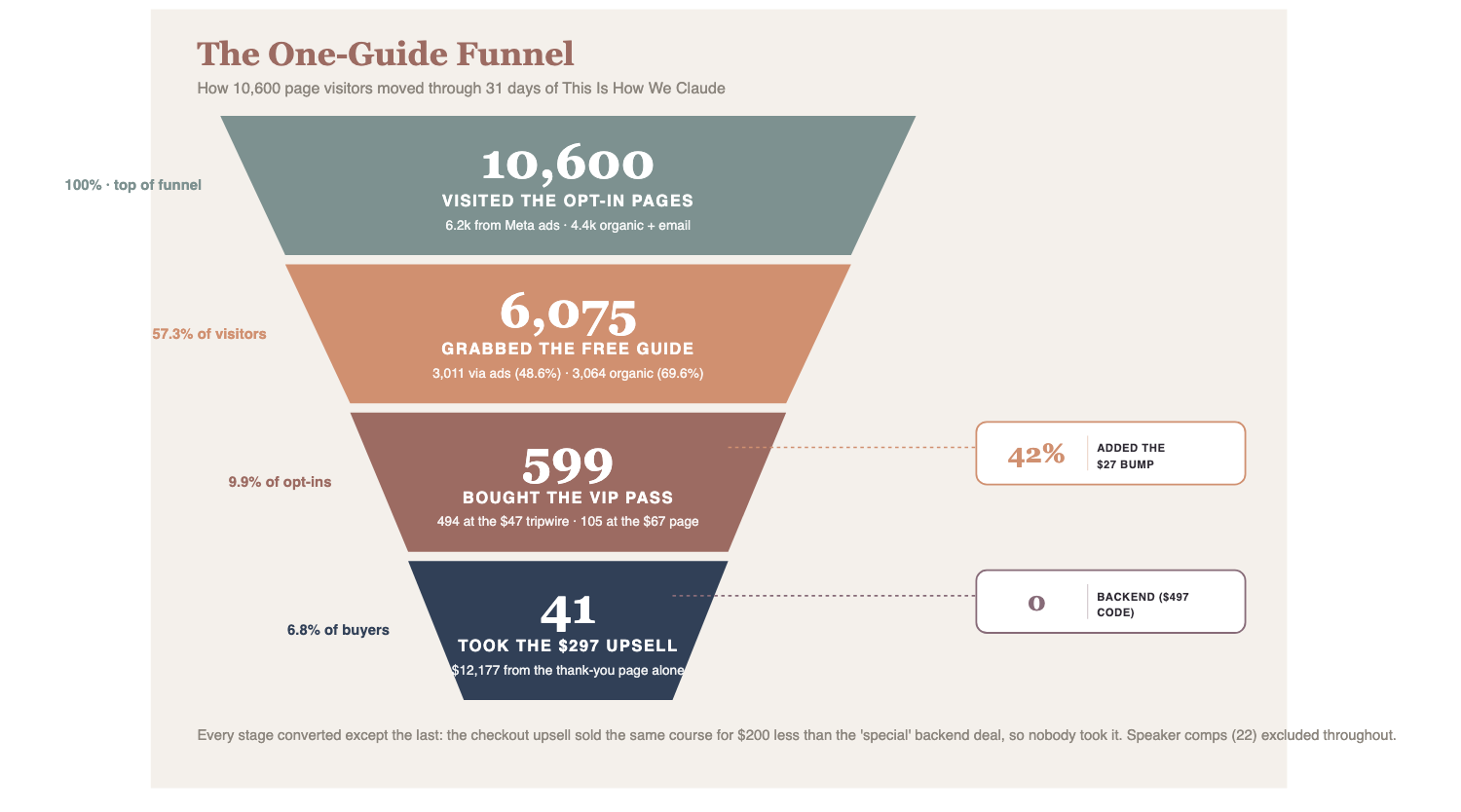
Schematic, not to scale. The 599 buyers include the 494 tripwire takers from the tier above plus 105 who bought later at $67; the 22 comped speaker passes aren't counted anywhere in this graphic.
The stages, walked
Opt-in — 57.3% blended
10.6k page visitors became 6,075 opt-ins. The ads page converted at 48.6% (3,011 opt-ins from 6.2k visitors); the organic/email page at 69.6% (3,064 from 4.4k). Both are excellent — the ads page number on cold traffic is the one that still surprises me.
Tripwire — 8.4% of page visitors
5.9k people saw the $47 page inside the 30-minute window; 494 bought. That single honest countdown produced 77% of all pass revenue units.
Public $67 page — 4.2%
2.5k visitors all month, 105 buyers, mostly clustered around the VIP emails and the final 72 hours.
Checkout bump — 42.1%
252 of 599 buyers added Brand iOS at $27. Above the 25–30% benchmark; the offer matched the moment.
One-click upsell — 6.8%
41 took Scale Smart at $297 on the thank-you page. $12,177 — 24.8% of the launch's revenue — from a page nobody had to visit twice.
THE SHAPE OF THE LAUNCH
Sales by day
31 selling days. The pattern: a strong open (launch week = 19.8% of revenue), a steady ad-fed middle that never dipped below $410 on the worst day, and a close that was solid but quieter than it should have been.
Aug 31 was the biggest day at $6,159 — 12.5% of the month. But the final 72 hours took only 21.1% of total revenue. My deal weeks concentrate 40%+ into the close; this one didn't, partly because the daily ad flow made every day a mini-launch, and partly because the closing emails were the weakest performers of the sequence (2.0–2.2% CTR vs 13.3% on launch day).
| WINDOW | REVENUE | % OF MONTH |
|---|---|---|
| Aug 1–7 · launch week | $9,735 | 19.8% |
| Aug 8–14 · ads + first VIP email | $10,336 | 21.1% |
| Aug 15–21 · the quiet middle | $6,820 | 13.9% |
| Aug 22–25 · roundtable window | $7,903 | 16.1% |
| Aug 26–28 · post-roundtable | $3,955 | 8.1% |
| Aug 29–31 · the close | $10,350 | 21.1% |
| THE CLOSE WAS POLITEMy deal weeks put 40%+ of revenue in the final 72 hours. This one put 21.1% there. The daily ad flow smoothed the curve, which is fine for cash flow and terrible for urgency. Next time the close gets twice the sends and a countdown. |
|---|
THE PAID ENGINE
Paid ads: the honest math
Two campaigns ran. The main one worked hard; the duplicate quietly didn't.
Meta attributed 280 purchases to the ads. At the real $81.97 per buyer, that's roughly $22,950 of ad-driven revenue on $14,178 of spend — a 1.62x direct ROAS, before counting a single future purchase from the 3,011 leads the ads added to the list at $4.71 each. The ads paid for themselves inside the month AND bought the audience for everything that comes after — including the fall sequel those leads were just told about.
| CAMPAIGN | SPEND | CLICKS (CTR) | PURCHASES | CPA |
|---|---|---|---|---|
| This is How We Claude — August | $13,134 | 5,846 (2.28%) | 274 | $47.93 |
| TIHWC Round 2 (duplicate) | $1,044 | 314 (2.27%) | 6 | $173.97 |
| Total | $14,178 | 6,160 | 280 | $50.64 |
| REALITY-CHECKMeta's attribution is an estimate, so treat 1.62x as directional. The un-fudgeable numbers: $4.71 per opt-in on a funnel that converts opt-ins to buyers at 9.9%, meaning a modeled ~$47.60 cost per buyer against $81.97 collected per buyer. Same verdict either way: this scales. |
|---|
The contributor-affiliate engine
All 16 contributors got 50% commission and a swipe page. 16 tracked at least one sale; together they drove $10,319 — 21% of launch revenue — earning $5,160 in commissions.
Steph Blake led with 45 attributed sales, and the top four affiliates drove 58% of all affiliate revenue. But the promo-proof log tells the quieter story: by Aug 26 only 5 of 16 contributors had logged the promotion they agreed to (1 solo + 2 mentions). Some clearly promoted without logging — the attribution proves it — but the agreement was under-enforced until the automated day-before reminder.
| AFFILIATE | SALES | REVENUE DRIVEN |
|---|---|---|
| Steph Blake | 45 | $1,828 |
| Destini Copp | 27 | $1,519 |
| Monica Froese | 34 | $1,411 |
| Ruth Poundwhite | 28 | $1,209 |
| 12 more affiliates | 110 | $4,352 |
| Total (21% of launch revenue) | 244 | $10,319 |
| THE ZERO-LOG DIAGNOSTICIf the eight contributors with no logged promo had each sent one solo email at the median performer's result (~$700 driven), that's ~$5,600 more revenue and bigger commission checks for them. The fix isn't chasing people on Aug 30 — it's moving the earning math (4,000+ attendees, 12% conversion, 42% bump) into contributor email #2, in week one. |
|---|
Traffic + conversion, every step
Fathom's August numbers for the funnel pages, matched against Kartra's transactions. This is the whole funnel in one table.
| STEP | IN | OUT | CONVERSION |
|---|---|---|---|
| Ads opt-in page → opt-in | 6.2k | 3,011 | 48.6% |
| Organic opt-in page → opt-in | 4.4k | 3,064 | 69.6% |
| Opt-in → any paid pass | 6,075 | 599 | 9.9% |
| Tripwire page → $47 buyer | 5.9k | 494 | 8.4% |
| $67 page → buyer | 2.5k | 105 | 4.2% |
| Buyer → bump | 599 | 252 | 42.1% |
| Buyer → $297 upsell | 599 | 41 | 6.8% |
| Buyer → $497 backend | 628 | 0 | 0% |
| EARNINGS PER LEAD**$8.08 per opt-in** ($49,099 ÷ 6,075). That's the number that sets next event's ad budget: at $4.71 a lead, every dollar into the winning campaign returned $1.62 inside the month, list growth free. |
|---|
STEAL THIS ONE
What the sponsors got (and what I learned about placements)
Four sponsors paid $1,000 each. Their gift links tell a clean story: sponsor gifts averaged 503 clicks; non-sponsor contributor gifts averaged 184. The 2.7x gap is the placements working — the dedicated feature email (64% open, 16.3% CTR — the best email of the entire launch), the image cards in the reminder emails, the Skool spotlights, the guide's front pages, and the logo bars.
Monica's gift led everything at 567 clicks, then Steph Blake (542), Kelly (469), Her AI Club (434). The guide PDF itself was pulled 4,404 times.
- Image cards beat text blocks. The card-based feature email out-clicked every text-block sponsor mention by 3x+. Cards from day one next time.
- Placement ≠ one email. The gap compounded across nine surfaces. Sponsors bought presence, and presence is what converted.
- At $1,000 a spot against these click numbers, the sponsor offer looks underpriced. But I'm not repricing on my click data alone: first I'm asking each sponsor how many leads actually landed on their list, and the sequel call (raise, add spots, or hold) waits on their real numbers.
THE HONEST MATH
Money left on the table
Ranked by size, which makes this the sequel's to-do list.
1. The dead backend — ~$5,000+
Zero HOWWECLAUDE redemptions because checkout sold the same course for $200 less three weeks earlier. Even a modest 2% of the 587 non-upsell buyers at $397 is ~$4,700, and a purpose-built backend should beat that. Biggest structural fix on the list.
2. The silent contributors — ~$5,600
Eight of sixteen never logged (and mostly never sent) their agreed solo email. At the median affiliate's ~$700 driven per solo, that's ~$5,600, plus their own halves. Enforcement moved to week one fixes this for free.
3. The quiet close — ~$3,500
Final-72h share was 21% against my usual 40%+, and the closing emails clicked at 2.0–2.2% vs the sequence's 4–5% norm. Matching even the roundtable window's daily pace through the last week is ~$3,500 more. Louder close, more sends, real countdown.
4. The Round 2 ad duplicate — ~$1,300
$1,044 at a $173.97 CPA while the main campaign bought purchases at $47.93. Consolidating that spend into the winner models ~16 more buyers. Kill duplicates inside a week next time.
5. The $67 page — asked and answered: not a leak
4.2% vs the tripwire's 8.4%. My verdict: the tripwire did exactly what I built it to do, and 105 people still paying $67 on top of it was upside, not cannibalization. No A/B needed. If I test anything next round, it's a stepped ladder — $47 tripwire, then $97, then $497.
| THE BOTTOM LINE VERDICT****The honest win: $49k banked in a month at 60% margin after ads and commissions, on a funnel Claude mostly built, that also added ~4,000 net-new subscribers and 599 buyers to the ecosystem — 65% of the guide's opt-ins (3,875) had never been on my list, while the other 2,073 were existing subscribers grabbing the guide. The ranked leaks total roughly $15k — and every one of them is a process fix, not a mystery. |
|---|
Notes for next time
What I said I'd fix last time
- This was the first collab-guide event, so there's no prior edition to carry notes from. The whole build is now a reusable skill (sws-collab-guide-launch), and this list feeds straight into it — the fall sequel starts from here, not from zero.
What I'm changing next time
1. Rebuild the backend rung: different product or genuinely better deal than the checkout upsell, or cut it.
2. Put the affiliate earning math in contributor email #2 and gate next-event invites on promo compliance.
3. Close louder: 2x sends on the final two days, a real countdown, and hold back one proof asset for the last 48 hours.
4. Scale the winning ad campaign earlier; audit for duplicate campaigns weekly.
5. Sponsor placements as image cards from day one, and decide sponsor pricing after this round's sponsors report how many leads they actually captured.
6. Set Good/Better/Best targets before launch day so the debrief can grade against them.
7. Keep the tripwire exactly as is. If testing anything, try a stepped price ladder — $47, then $97, then $497.
THE WHOLE POINT
Eight things you can steal
1. Run an honest countdown. The 30-minute tripwire window was real, it expired, and 82% of buyers came through it. Deadlines convert when your list learns you mean them.
2. Match the bump to the buying moment. $27 next to a $47 yes hit 42.1% attach. It’s the same yes, one inch wider.
3. Never price the backend worse than the checkout. My $297 upsell beat my $397 backend “deal” to the same buyers, and the backend sold zero.
4. Wrap every link in a redirect you control. 35 PrettyLinks meant broken links, a wrong URL, and a regenerated PDF all got fixed without touching a single page or email.
5. Give partners the earning math in dollars, in week one. Goodwill got 5 of 16 contributors to log promo proof. Dollars move calendars.
6. Sell sponsors presence, not a placement. Nine surfaces compounded to 2.7x the clicks, and image cards in the sponsor’s own words beat text blocks about them 3x.
7. Build the machine so launch day doesn’t need you. Purchase to welcome email in 15 seconds — and day one did $2,765 while I test-drove e-bikes with my kids.
8. Close louder than you open. My launch email out-clicked my close 6x, and the final 72 hours took 21% of revenue instead of my usual 40%+. Double the final-48 sends and hold back one proof asset for the end.